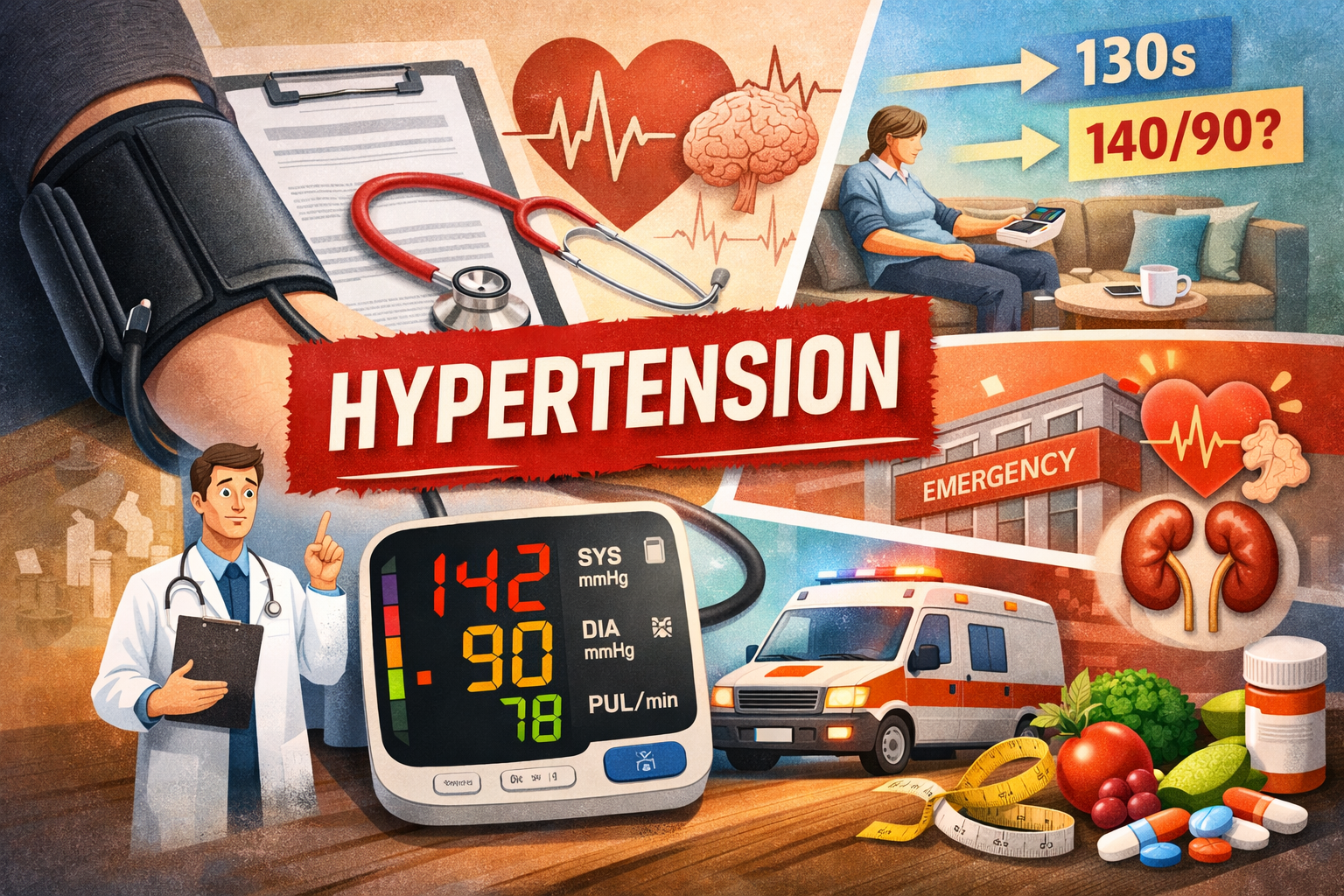


A single high blood pressure reading does not automatically mean you have hypertension. It means you have a signal worth checking properly. What matters more is whether the number stays high over time, whether it is high at home as well as in the clinic, and whether you already have other risk factors such as diabetes, kidney disease, prior stroke, or known heart disease.
That is why major guidelines now converge on one practical idea: if a clinic reading is elevated, the next step is usually confirmation with home or ambulatory monitoring before you label it “real” hypertension and start long-term treatment.
First: what actually counts as “high” blood pressure?
This is where people often get confused, because different guidelines do not use exactly the same thresholds.
In current U.S. guidance, 130/80 to 139/89 is already classified as stage 1 hypertension, while 140/90 or higher is stage 2 hypertension. In UK guidance, the formal diagnosis usually begins with a clinic blood pressure of 140/90 or higher, confirmed by an average home or daytime ambulatory reading of 135/85 or higher. European guidance still keeps 140/90 as the formal definition of hypertension, even though treatment targets have become more intensive.
For most readers, the useful takeaway is simpler than the guideline debate. A confirmed, repeated blood pressure of 140/90 or above is a clear sign that needs attention. A repeated average in the 130s over 80s also matters, especially if you already have elevated cardiovascular risk. Blood pressure is not a switch that suddenly becomes dangerous at one exact number. Risk rises gradually as the average rises.
Why a single office reading is often misleading
Blood pressure is unusually sensitive to context. It rises with stress, poor sleep, caffeine, nicotine, a full bladder, recent exercise, pain, and the simple tension of being in a clinic.
That is why current screening guidance recommends office measurement first, then out-of-office confirmation before treatment decisions are made. Ambulatory blood pressure monitoring, where a device measures pressure through the day and night, has the strongest evidence base. Home monitoring is also an accepted way to confirm the diagnosis when done correctly.
This is also where the white coat effect matters. In plain language, your blood pressure looks high in the office, but your usual blood pressure outside the clinic is meaningfully lower. The reverse can also happen. Masked hypertension means clinic readings look normal, but home or ambulatory readings are high. Both are major reasons home measurements matter.
The numbers that matter most are your home averages
If you want the most useful answer to the question “Do I really have high blood pressure?”, focus less on one number and more on your average over several days, measured the right way.
UK guidance recommends, for diagnosis by home monitoring, taking two readings at least one minute apart, twice daily, for at least 4 days and ideally 7, then discarding day 1 and averaging the rest. That gives a much more realistic picture than a single anxious reading in a clinic waiting room.
Technique matters more than most people realize. Blood pressure should be measured on a bare upper arm, after about 5 minutes of quiet rest, with back supported, feet flat on the floor, arm supported at heart level, and no talking during the reading. The monitor should be a validated upper-arm device with the correct cuff size. Current American guidance also warns against relying on cuffless devices such as smartwatches for diagnosis or treatment decisions.
When lifestyle-first is still reasonable
A lifestyle-first approach is often reasonable when blood pressure is only mildly elevated and the overall risk picture is still low.
Current U.S. guidance recommends lifestyle treatment for everyone with elevated blood pressure or hypertension, and for lower-risk adults with average blood pressure 130/80 or higher, it allows an initial 3- to 6-month trial of lifestyle change before medication if cardiovascular risk is low. NICE takes a similar practical approach: stage 1 hypertension does not always mean automatic medication, especially if there is no organ damage, no diabetes, no kidney disease, no established cardiovascular disease, and no clearly elevated 10-year risk.
That approach makes sense because lifestyle changes do work. The original DASH trial showed that a dietary pattern rich in fruits, vegetables, and low-fat dairy lowered blood pressure compared with a typical control diet. The DASH-Sodium trial then showed that cutting sodium lowered blood pressure further, and the combination of a DASH-style pattern plus lower sodium worked best.
For many people, “lifestyle-first” should mean something concrete, not vague advice. Start with the levers that actually move blood pressure: reduce sodium, cut back on ultra-processed food, build regular physical activity you can repeat every week, reduce alcohol if it is frequent, and lose some weight if you are carrying excess weight.
When medication should move up the list
Medication moves up quickly when the pressure is clearly high or when the stakes are already high.
In current U.S. guidance, drug therapy is recommended for all adults with average blood pressure 140/90 or higher, and also for selected adults with 130/80 or higher if they have clinical cardiovascular disease, prior stroke, diabetes, chronic kidney disease, or a sufficiently high estimated 10-year cardiovascular risk. For lower-risk adults with readings in that same range, medication is recommended if blood pressure remains elevated after the initial lifestyle window.
UK guidance is a little more conservative, but the logic is similar. It recommends medication for persistent stage 2 hypertension at any age, and discussion of medication for persistent stage 1 hypertension in adults under 80 if there is target organ damage, cardiovascular disease, renal disease, diabetes, or elevated 10-year cardiovascular risk.
The reason guidelines have become more comfortable with earlier treatment is that large trials have shown benefit from better blood pressure control. SPRINT found that more intensive systolic blood pressure control lowered major cardiovascular events and all-cause mortality in higher-risk adults without diabetes, though it also increased some adverse events. More recently, BPROAD found benefit from intensive systolic control in adults with type 2 diabetes at elevated cardiovascular risk.
These trials do not mean everyone should chase the lowest possible number. They do explain why clinicians are less relaxed about “borderline” hypertension than they were a decade ago.
What to do first if your readings are high
If your first clinic reading is high, do not panic and do not self-diagnose from one number. Confirm it properly. Use a validated upper-arm cuff at home, follow a real measurement protocol, and track readings for a week. Bring the log to your clinician. If your home average stays high, that is far more useful than one dramatic number in a stressful setting.
At the same time, start the basics immediately because they help whether you end up needing medication or not: tighten up sodium, shift toward a DASH-style eating pattern, move regularly, cut back on alcohol, and make sure your measurement technique is actually correct before assuming your blood pressure is truly resistant.
If your numbers are in the 130s over 80s, you may have room for a smart lifestyle-first period. If they are repeatedly 140/90 or higher, or if you already have diabetes, kidney disease, prior stroke, or known cardiovascular disease, the medication conversation usually should not wait too long.
Where the line becomes urgent
Some numbers are not “watch and wait.”
Blood pressure above 180/120 is considered severe hypertension, and if it comes with symptoms such as chest pain, shortness of breath, back pain, weakness, numbness, vision change, or trouble speaking, that is an emergency.
Bottom line
The smartest way to think about blood pressure is this: one office reading is a signal, repeated averages are what matter most, and your overall risk determines how fast to act.
Home measurements are no longer a side note. They are often the difference between overreacting to a white coat reading and catching real hypertension early enough to prevent stroke, heart disease, kidney damage, and long-term complications.
Plan: What to Do If Your Blood Pressure Is High
1. Do not conclude anything from one reading alone.
A single high number is not enough for a diagnosis. It is a reason to check things properly.
2. Start measuring at home the right way.
Use a validated upper-arm monitor. Measure after 5 minutes of rest, seated, with your arm at heart level. Take two readings at least one minute apart, morning and evening.
3. Track your readings for at least 4 to 7 days.
Do not focus on random spikes. Look at the average across several days. That gives a much better picture of your real blood pressure.
4. Check the basic factors that can distort the numbers.
Poor sleep, stress, caffeine, nicotine, alcohol, pain, recent exercise, too much sodium, and bad measurement technique can all push readings up.
5. If the numbers are only mildly elevated, start with lifestyle changes.
Cut back on sodium, reduce ultra-processed food, move more consistently, lose weight if needed, and reduce alcohol if it is frequent.
6. Bring your home log to your clinician.
Do not rely on memory. A written record helps distinguish real hypertension from white coat effect and helps catch masked hypertension too.
7. Do not delay treatment if the blood pressure stays clearly high.
If readings repeatedly stay at 140/90 or above, or if you already have diabetes, kidney disease, prior stroke, or cardiovascular disease, medication usually needs to be part of the discussion.
8. Know the red-flag threshold.
If blood pressure is above 180/120, especially with symptoms like chest pain, shortness of breath, weakness, numbness, vision changes, or speech problems, seek urgent medical help.
Sources
- USPSTF — Hypertension in Adults: Screening
- AHA/ACC 2025 — High Blood Pressure Guideline: Top Things to Know
- NICE NG136 — Hypertension in Adults: Diagnosis and Management
- CDC — How to Measure Your Blood Pressure at Home
- NEJM — A Clinical Trial of the Effects of Dietary Patterns on Blood Pressure (DASH)
- NEJM — Effects on Blood Pressure of Reduced Dietary Sodium and the DASH Diet
- American Heart Association — High Blood Pressure Top 10
- SPRINT Trial — A Randomized Trial of Intensive versus Standard Blood-Pressure Control
- BPROAD Trial — Intensive Blood-Pressure Control in Patients with Type 2 Diabetes