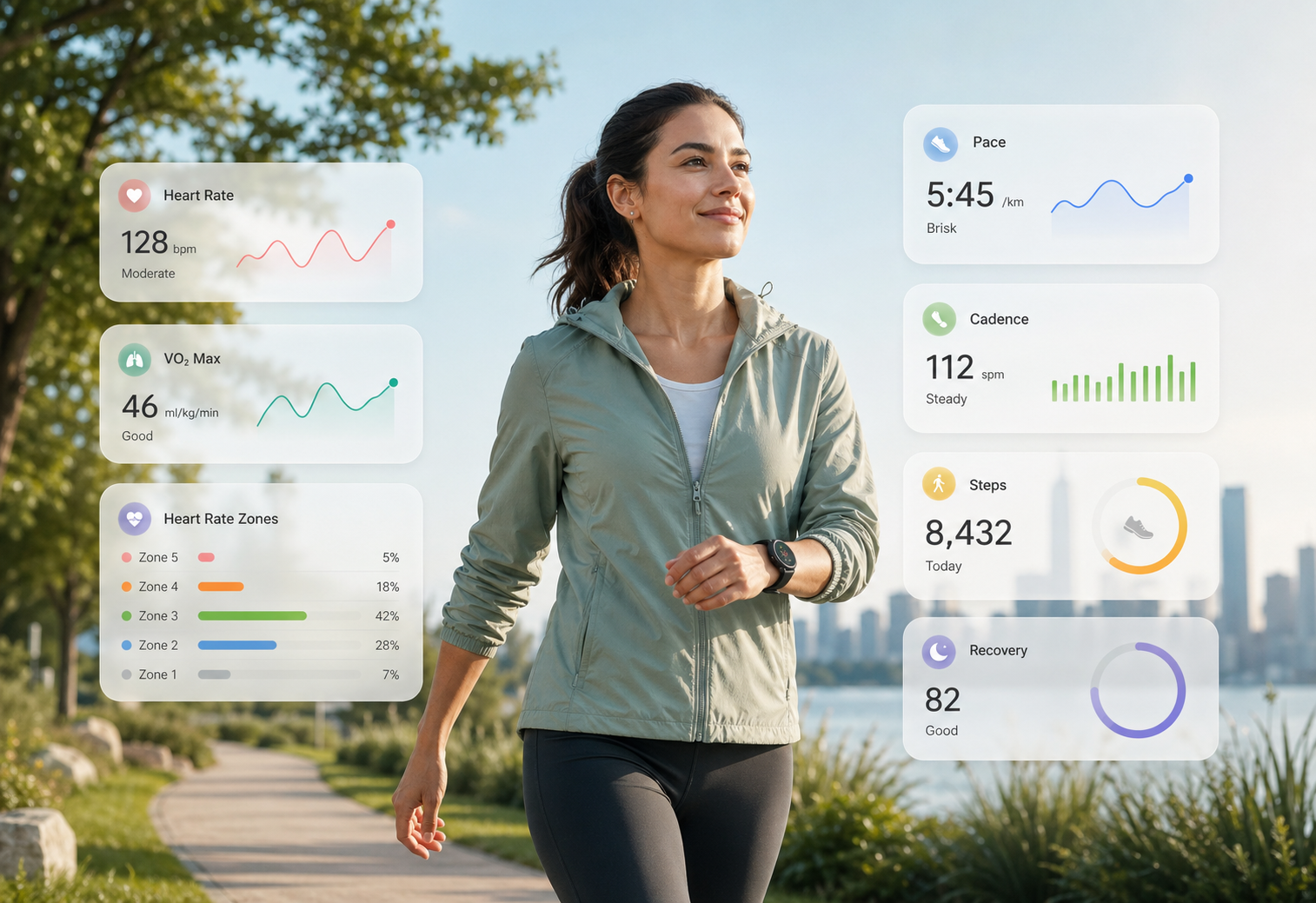


Fitness trackers have changed the way we think about health, mostly by making the invisible feel measurable. A walk is no longer just a walk; it becomes a combination of steps, pace, cadence, heart rate, calories, zone minutes, training load, recovery status, HRV, and a VO₂max estimate that may or may not move in the direction you expected.
At first, this can feel empowering because health stops being vague and starts showing up on a screen. You can see patterns, compare one week with another, and notice progress that would otherwise be easy to miss. For many people, that feedback helps build consistency, and consistency is where most health improvements begin.
Over time, though, the same numbers can start to demand more attention than they deserve. You go outside for an easy walk and wonder whether it “counted.” You finish a workout and judge the session by the color of the zone chart. You wake up feeling fine, then a readiness score tells you to doubt your own body. Your VO₂max estimate drops by one point, and a normal fluctuation suddenly feels like a setback.
This is where fitness tracking becomes complicated. Metrics can be genuinely useful, especially when they help you move more often, recover more intelligently, and notice long-term trends. They can also turn movement into a constant performance review, where every walk, workout, and recovery day is evaluated by an algorithm that only sees part of the story.
The more useful question is not whether fitness metrics are good or bad, since the answer depends on how they are used. The better question is which numbers deserve your attention, which ones should stay in the background, and which ones are mostly decorative unless they change your behavior in a helpful way.
Start with the basics, because the guidelines are simpler than the apps
Most fitness apps look more complicated than the actual public health guidelines. For adults, the core recommendation is familiar and surprisingly moderate: aim for 150 to 300 minutes of moderate-intensity aerobic activity per week, or 75 to 150 minutes of vigorous activity, plus strength training at least two days per week. The World Health Organization, CDC, and American Heart Association all communicate this basic structure in similar terms. [1, 2, 3]
There is a reason the recommendation is written this way. Public health does not begin with perfect zone distribution, advanced readiness algorithms, or a dashboard full of biometric scores. It begins with regular movement, enough intensity to create a physiological stimulus, and enough repetition over months and years for the body to adapt.
That hierarchy matters because it protects you from confusing the interface with the goal. A person who walks briskly most days, does strength work twice a week, and gradually improves fitness is already doing the main work, even if the data looks ordinary. A person with a premium device who sits for most of the day is mostly collecting elegant information about a simple problem.
The device may be smart, but the body still needs movement.
Weekly movement volume is still the main number
If you had to choose one metric for health, it would probably not be VO₂max, HRV, active calories, or training load. The most useful starting point is much simpler: how many minutes per week do you move with meaningful effort?
This number is not perfect. Thirty minutes of slow strolling is different from thirty minutes of uphill walking, cycling may not appear in a step count, and strength training may look unimpressive in an aerobic dashboard. Even so, weekly active minutes answer the question that matters most for behavior: are you showing up often enough to give your body a consistent signal?
For many people, the first useful target is to build toward 150 minutes per week of moderate-intensity activity. That might mean five brisk 30-minute walks, three longer sessions, or a mix of cycling, swimming, hiking, dancing, jogging, rowing, and sports. The exact format matters less than the pattern, because regular movement repeated often enough is what creates the health signal.
Verdict: weekly movement volume is health-critical because it is the base layer that makes most other metrics meaningful.
Intensity matters, but you do not need to worship zones
Once movement becomes regular, intensity becomes the next important question. Some activity is valuable simply because it breaks up sitting and increases total daily movement, but health guidelines also care about whether the effort reaches a level that challenges the cardiovascular system.
Heart rate can help estimate that intensity, although it should not be treated as the only source of truth. The simplest tool is still the talk test: during moderate activity, you can talk, although you probably cannot sing; during vigorous activity, you can only speak a few words before needing to breathe. The CDC uses this as a practical way to explain exercise intensity. [4]
This matters because it brings the focus back to the body. Heart rate zones can estimate effort, but the number is affected by heat, caffeine, stress, sleep, dehydration, medication, illness, fitness level, and sensor quality. A heart rate reading is data, yet breathing, perceived effort, and the ability to sustain the pace are also data.
The American Heart Association describes moderate intensity as roughly 50 to 70 percent of maximum heart rate and vigorous intensity as roughly 70 to 85 percent, although these ranges are broad guides rather than precise commands. [5] That distinction matters in real life, where the same heart rate can feel very different depending on the day.
Use heart rate as an orientation system. If your watch says an easy walk was too light while you are recovering from illness or a brutal week, that easy walk may be exactly what you need. If your watch says the zone is appropriate while the effort feels wrong, your body may be giving you information the algorithm has missed.
Verdict: intensity is health-critical, while exact zone precision is optional for most people.
Heart rate is useful, but it is really a family of signals
Heart rate is one of the best everyday fitness signals because it reacts quickly and gives immediate feedback. Walk faster and it rises; stop and it falls; improve your fitness and the same route often costs less; sleep badly, drink alcohol, get sick, train too hard, or spend a day under stress, and your heart rate may drift higher than usual.
The mistake is treating heart rate as a single metric. In practice, resting heart rate, exercise heart rate, and heart rate recovery each tell a different part of the story, and they become most useful when you compare trends rather than isolated readings.
Resting heart rate
Resting heart rate is a useful background marker. In population studies, higher resting heart rate has been associated with higher all-cause and cardiovascular mortality risk. [10] For an individual, though, the trend is much more useful than a single number on a single morning.
If your usual resting heart rate is around 58 and it stays near 68 for several days, something has likely changed. It could be poor sleep, stress, alcohol, illness, overreaching, heat, or dehydration. The number does not diagnose the cause, but it tells you that the baseline moved and that your body may be carrying more load than usual.
Exercise heart rate
Exercise heart rate helps you understand how hard your body is working during activity, but it should not turn every session into a chase for higher numbers. For health-oriented training, many people do better when easy days stay genuinely easy and harder efforts are added gradually.
One of the best questions is simple: at the same walking pace, is your heart rate slowly becoming lower over time? If yes, that often suggests improved efficiency, because your body can handle the same external work with less internal strain.
Heart rate recovery
Heart rate recovery measures how quickly your heart rate drops after exercise. Research links weaker heart rate recovery with higher risk of cardiovascular events and all-cause mortality. [11] For everyday use, the key is comparison under similar conditions, because a hard interval workout on a hot day is not comparable to an easy walk in cool weather.
Verdict: resting heart rate, workout heart rate, and heart rate recovery are useful, especially as trends; obsessing over every spike usually adds more noise than insight.
VO₂max matters, but your watch estimate is not a verdict
VO₂max is the maximum amount of oxygen your body can use during intense exercise, and in a broader sense it reflects cardiorespiratory fitness, or CRF. This is one of the strongest fitness-related markers in health research. The American Heart Association has argued that cardiorespiratory fitness should be treated almost like a clinical vital sign because it predicts cardiovascular disease and mortality risk beyond many traditional risk factors. [6]
A 2024 overview in the British Journal of Sports Medicine found that higher CRF is strongly and consistently associated with lower risk of premature mortality and chronic disease. The review represented more than 20.9 million observations from 199 cohort studies. [7] In other words, the underlying capacity that VO₂max points to is genuinely important.
The number on your watch, however, needs context. A laboratory VO₂max test and a wearable estimate are different things. Consumer devices estimate VO₂max using heart rate, pace, GPS, age, sex, body weight, and proprietary algorithms. These estimates can be helpful, especially when based on exercise data, but individual error can be meaningful. A 2022 meta-analysis found that wearable estimates based on exercise information performed better than resting-based estimates, while still needing improvement for individual use in sport and clinical settings. [14]
The best way to use wearable VO₂max is as a long-term trend rather than a daily verdict. Instead of reacting to a one-point drop, ask whether your estimated fitness is improving over months, whether you can walk faster at the same effort, whether climbing stairs feels easier, whether you recover better from a familiar route, and whether your easy pace actually feels easier than before.
VO₂max is valuable because it points to a real biological capacity. It becomes a problem when the estimate turns into a daily self-worth score.
Verdict: cardiorespiratory fitness is health-critical, while wearable VO₂max is most useful as a long-term trend.
Heart rate zones are a tool, not a personality test
Heart rate zones make workouts feel organized, which is one reason they are so appealing. Zone 1, Zone 2, Zone 3, Zone 4, and Zone 5 give effort a clean structure, and that structure can be useful when you want to dose intensity more deliberately.
Zones can help you avoid making every workout too hard, build aerobic capacity, structure intervals, and distribute training load more intelligently. They are especially useful for endurance athletes or anyone training toward a performance goal.
For general health, however, you do not need to turn every walk into a zone audit. A brisk walk that changes your breathing is useful even if your watch labels much of it Zone 1. A recovery walk is useful even if it does not count as vigorous. A hill that briefly lifts your heart rate can be a good stimulus even if the chart looks messy.
The workout is the physiological signal, and the colored chart is only an approximation. For most people, a simpler model works well enough: easy means you can speak comfortably; moderate means you can talk, but not sing; hard means you can speak only in short phrases; very hard means short intervals used carefully.
Verdict: managing intensity is health-critical, while detailed zone distribution is nice to have unless you train for performance.
Walking pace is more important than it looks
Walking pace is one of the most underrated health metrics because it is simple, accessible, and surprisingly informative. It does not require a lab, a premium subscription, or a complex dashboard, yet it tells you a lot about how your body functions in the real world.
Comfortable walking speed reflects more than leg movement. It is influenced by cardiovascular capacity, strength, balance, coordination, confidence, joint comfort, and nervous system function. In older adults, gait speed has been associated with survival; a 2011 JAMA pooled analysis of nine cohorts found that gait speed was linked with survival in older adults. [8]
For everyday life, walking pace is easy to understand. Can you walk faster than before without feeling crushed? Can you handle a small hill without stopping? Can you keep a brisk pace while breathing steadily? Is your usual route becoming easier? These questions translate fitness into real-world capacity rather than abstract scores.
Cadence research often uses around 100 steps per minute as a rough threshold for moderate-intensity walking in adults. This is not universal, since height, age, stride length, terrain, slope, and health status all matter, but it is a useful answer to a common question: how fast is fast enough? [9]
You do not need to count every step. The practical version is to walk fast enough that your breathing clearly changes while keeping the pace sustainable. For an inactive person, that may be a modest pace; for a fitter person, it may require hills, intervals, or a faster route.
Verdict: walking pace is high-value because it is one of the best low-tech signals for health-oriented movement.
Steps are useful, but 10,000 is not a magic number
Step count became popular because it is easy to understand. It turns the vague instruction to move more into a visible number, and that can be powerful, especially for people who are currently inactive. Steps encourage walking to the store, taking stairs, pacing during calls, and breaking up long sitting blocks.
Large studies generally support the direction. More daily steps are associated with better health outcomes, especially when people move from low activity to moderate activity. A 2022 Lancet Public Health meta-analysis found that more steps per day were associated with progressively lower all-cause mortality risk up to a level that varied by age. [12]
A 2025 Lancet Public Health systematic review and dose-response meta-analysis looked beyond mortality and supported the idea that meaningful benefits occur well below the old 10,000-step target. [13] This is the important part: 10,000 steps is a useful cultural reference point, but it is not a biological law.
A better approach is personal progression. If you average 3,000 steps, moving toward 4,000 or 5,000 may matter. If you average 5,000, then 6,000 or 7,000 may be a useful next step. If you already average around 8,000, you may gain more by improving intensity, strength, mobility, or recovery rather than chasing a higher step count.
Step count also misses many useful activities, including cycling, swimming, strength training, rowing, carrying, sport, and physical work. It says little about intensity unless you pair it with pace, cadence, or heart rate.
Verdict: steps are useful, especially for inactive people, but they are incomplete as a fitness metric.
HRV and readiness scores belong in the context layer
Heart rate variability, or HRV, measures variation in the time between heartbeats. It reflects autonomic nervous system regulation and is affected by sleep, stress, alcohol, illness, training load, recovery, breathing, and measurement conditions. That is why HRV is interesting, and it is also why HRV can be noisy.
Research supports HRV as a meaningful prognostic marker at the population level. A 2022 meta-analysis examined HRV parameters in relation to all-cause and cardiac mortality. [15] Daily consumer use, however, is a different situation, because a watch or ring is trying to turn a complex and variable signal into simple advice.
HRV is most useful as a trend under consistent conditions. If HRV is unusually low for several days, resting heart rate is elevated, and you feel tired, it is reasonable to reduce intensity and prioritize recovery. It is much less useful when one morning score decides your whole day despite how you actually feel.
Readiness scores, body battery, and recovery status have the same limitation. They compress many imperfect signals into one confident-looking number. Sometimes that number helps by confirming what you already sense; sometimes it overrides common sense and makes you doubt a body that feels perfectly fine.
Verdict: HRV is context, and readiness scores are optional prompts rather than diagnoses.
Active calories are less useful than they look
Active calories feel important because they connect movement to weight control, but the problem is precision. Energy expenditure matters, yet consumer devices estimate it with enough uncertainty that many people should avoid using active calories as a precise eating budget.
If your watch says you burned 420 active calories, that does not mean you should automatically eat back 420 calories. It also does not mean the workout was more valuable than a lower-calorie session that improved strength, mobility, aerobic base, or mental health.
Wearables are generally better at measuring heart rate than estimating energy expenditure, and even heart rate accuracy varies by device, activity type, skin tone, movement, and conditions. A 2024 umbrella review on consumer wearable accuracy found that many commercial devices still lack validation across common biometric outcomes. [16]
Calories can be directionally interesting, but they should rarely become the main score for movement.
Verdict: active calories are nice to have, and for most people they should not guide major decisions.
A simpler dashboard for real health
If you like metrics but want to stay sane, the best solution is often to reduce the dashboard rather than add another score. Most people can get a useful picture of health-oriented movement by tracking five things.
First, track weekly active minutes and build toward at least 150 minutes of moderate-intensity activity per week. Second, track brisk walking sessions, meaning several moments each week when you walk fast enough that your breathing clearly changes. Third, track strength sessions and aim to train major muscle groups at least two days per week.
Fourth, watch your resting heart rate trend across days and weeks rather than reacting to one isolated morning. Fifth, follow a broader fitness trend through VO₂max estimate, walking pace, stair tolerance, or recovery from a familiar route.
That is enough for most people. It covers volume, intensity, strength, recovery context, and cardiorespiratory fitness without turning health into a cockpit.
The device should be the instrument panel, not the steering wheel
A useful metric improves behavior. It helps you walk more often, notice when intensity is too low, slow down when recovery is poor, or see progress that would otherwise be invisible.
A bad relationship with metrics feels different. You start judging every walk, worrying about normal fluctuations, outsourcing body awareness to the app, and chasing scores that only partly map to health. At that point, the device is no longer supporting the habit; it is starting to manage it.
Use metrics to support the basics: move often, walk briskly sometimes, build strength, sit less, recover enough, and improve gradually. That is the real health stack.
Heart rate matters as a guide to intensity and as a trend over time. VO₂max matters because cardiorespiratory fitness is strongly linked with health outcomes, although the wearable number works best as a long-term signal. Zones matter as a training tool, but they lose value when every walk becomes a zone audit. Walking pace matters because it reflects real-world capacity. Steps matter when they help inactive people move more. HRV and readiness scores belong in the context layer. Active calories are less useful than they look.
The best fitness metric is not the one that looks most scientific. The best metric is the one that helps you consistently do the next healthy thing.
For most people, that next step is simple: go for the walk, make part of it brisk, do it again tomorrow, add strength twice a week, watch the long-term trend, and ignore the noise.
Your watch can help. It just should not become the reason you move.
References
- World Health Organization. WHO Guidelines on Physical Activity and Sedentary Behaviour. 2020. https://www.who.int/europe/publications/i/item/9789240014886
- Centers for Disease Control and Prevention. Adult Activity: An Overview. Updated December 20, 2023. https://www.cdc.gov/physical-activity-basics/guidelines/adults.html
- American Heart Association. American Heart Association Recommendations for Physical Activity in Adults. Updated January 19, 2024. https://www.heart.org/en/healthy-living/fitness/fitness-basics/aha-recs-for-physical-activity-in-adults
- Centers for Disease Control and Prevention. Measuring Physical Activity Intensity. https://www.cdc.gov/physicalactivity/basics/measuring/index.html
- American Heart Association. Target Heart Rates Chart. Updated August 12, 2024. https://www.heart.org/en/healthy-living/fitness/fitness-basics/target-heart-rates
- Ross R, Blair SN, Arena R, et al. Importance of Assessing Cardiorespiratory Fitness in Clinical Practice: A Case for Fitness as a Clinical Vital Sign. Circulation. 2016;134(24):e653-e699. doi:10.1161/CIR.0000000000000461. https://pubmed.ncbi.nlm.nih.gov/27881567/
- Lang JJ, Prince SA, Merucci K, et al. Cardiorespiratory fitness is a strong and consistent predictor of morbidity and mortality among adults: an overview of meta-analyses representing over 20.9 million observations from 199 unique cohort studies. British Journal of Sports Medicine. 2024;58(10):556-566. https://bjsm.bmj.com/content/58/10/556
- Studenski S, Perera S, Patel K, et al. Gait Speed and Survival in Older Adults. JAMA. 2011;305(1):50-58. doi:10.1001/jama.2010.1923. https://jamanetwork.com/journals/jama/fullarticle/644554
- Aguiar EJ, Gould ZR, Ducharme SW, et al. Cadence-based Classification of Minimally Moderate Intensity During Overground Walking in Older Adults. Journal of Aging and Physical Activity. 2019. https://pmc.ncbi.nlm.nih.gov/articles/PMC7200288/
- Zhang D, Shen X, Qi X. Resting heart rate and all-cause and cardiovascular mortality in the general population: a meta-analysis. CMAJ. 2016;188(3):E53-E63. https://pmc.ncbi.nlm.nih.gov/articles/PMC4754196/
- Qiu S, Cai X, Sun Z, Li L, Zuegel M, Steinacker JM, Schumann U. Heart Rate Recovery and Risk of Cardiovascular Events and All-Cause Mortality: A Meta-Analysis of Prospective Cohort Studies. Journal of the American Heart Association. 2017;6(5):e005505. https://pmc.ncbi.nlm.nih.gov/articles/PMC5524096/
- Paluch AE, Bajpai S, Bassett DR, et al. Daily steps and all-cause mortality: a meta-analysis of 15 international cohorts. The Lancet Public Health. 2022;7(3):e219-e228. https://pubmed.ncbi.nlm.nih.gov/35247352/
- Ding D, Mutrie N, Bauman A, et al. Daily steps and health outcomes in adults: a systematic review and dose-response meta-analysis. The Lancet Public Health. 2025;10(8):e668-e681. https://pubmed.ncbi.nlm.nih.gov/40713949/
- Molina-Garcia P, Notbohm HL, Schumann M, Argent R, Hetherington-Rauth M, Stang J, Bloch W, Cheng S, Ekelund U, Sardinha LB, Caulfield B, Ruiz JR. Validity of Estimating the Maximal Oxygen Consumption by Consumer Wearables: A Systematic Review with Meta-analysis and Expert Statement of the INTERLIVE Network. Sports Medicine. 2022. https://pubmed.ncbi.nlm.nih.gov/35072942/
- Jarczok MN, Koenig J, Mauss D, Fischer JE, Thayer JF. Heart rate variability in the prediction of mortality: A systematic review and meta-analysis. Neuroscience & Biobehavioral Reviews. 2022. https://pubmed.ncbi.nlm.nih.gov/36243195/
- Doherty C, Lee J, Whelan B, et al. Keeping Pace with Wearables: A Living Umbrella Review of Systematic Reviews Evaluating the Accuracy of Consumer Wearable Technologies in Health Measurement. Sports Medicine. 2024. https://pubmed.ncbi.nlm.nih.gov/39080098/