

Weight loss is one of the most discussed topics in health, and one of the most misunderstood.
Every few years, a new theory takes over. Carbs are the problem. Insulin is the problem. Meal timing is the problem. Metabolism is “damaged.” One perfect diet has finally cracked the code. The problem is that the evidence does not support that kind of story.
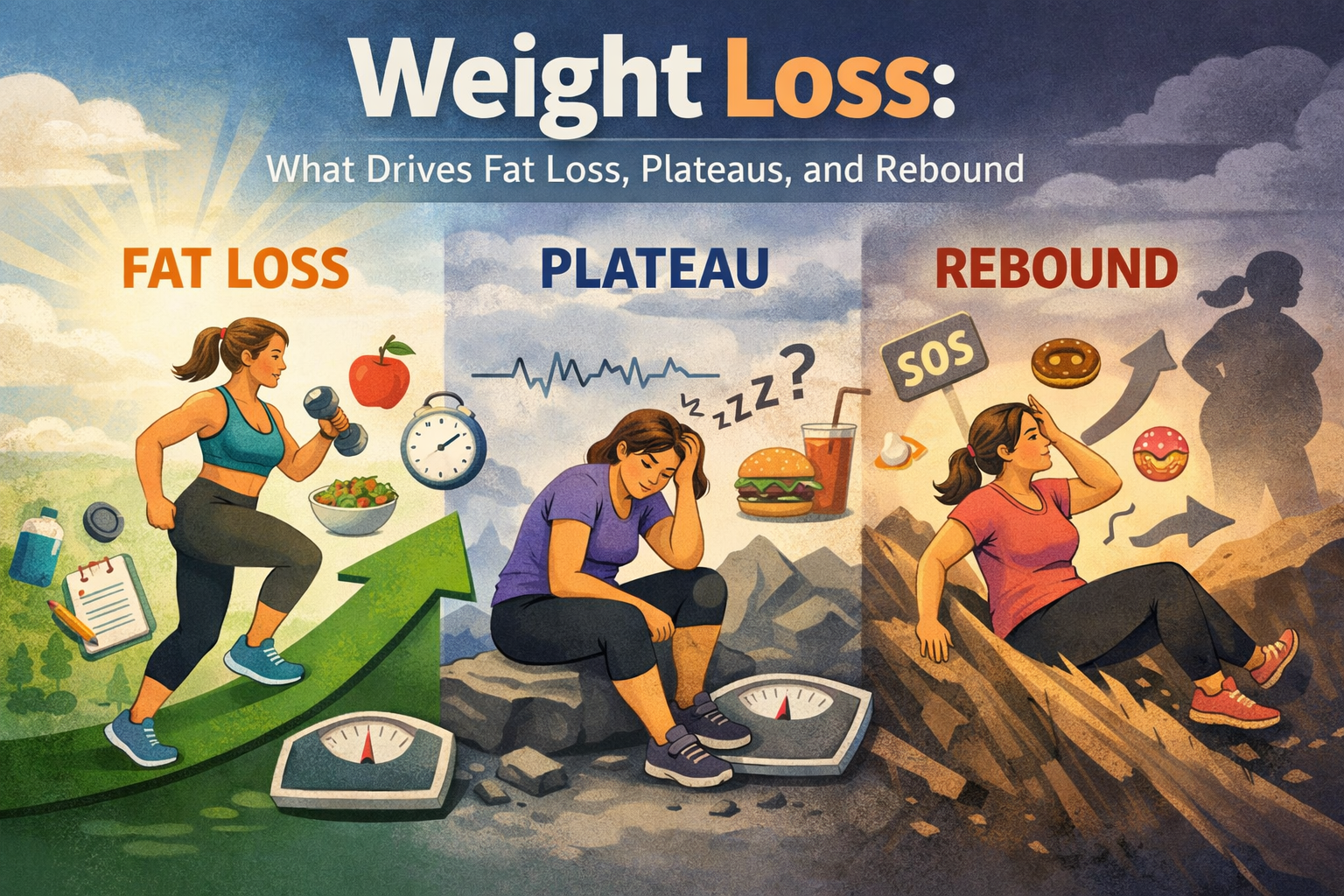
When you step back and look at large clinical trials, long-term follow-up studies, and modern obesity guidelines, a much clearer picture emerges. Fat loss is driven by a sustained energy deficit. Plateaus are common because the body adapts and behavior drifts over time. Rebound is common because the biological pressures that resist weight loss do not disappear once the initial treatment phase ends.
That is the useful frame. It is less exciting than diet mythology, but far more practical.
What actually drives fat loss
At the most basic level, body fat decreases when the body uses more energy than it takes in over time. That does not mean all foods affect the body in the same way. Some eating patterns improve satiety, reduce decision fatigue, and make it easier to stay consistent. Others make overeating more likely. But no diet produces meaningful fat loss unless it creates a real, sustained energy deficit.
This is where many weight-loss conversations go wrong. People often argue about whether low-carb, low-fat, Mediterranean, high-protein, or fasting is best, as if there should be one universal winner. Large trials do not show that. Different approaches can work. What matters most is whether a given approach helps someone eat less overall, keep hunger manageable, and stay with the plan long enough for results to accumulate.
That is why two people can lose weight on very different diets. One may do better with fewer carbs because it simplifies food choices and lowers appetite. Another may do better with a Mediterranean pattern because it fits social life and feels less restrictive. A third may benefit from a higher-protein approach because it improves fullness and helps preserve lean mass. These are different routes to the same underlying result.
The real driver is not diet ideology. It is adherence to a pattern that keeps energy intake below energy needs.
Why “the best diet” is usually the wrong question
A better question is not, “Which diet wins on paper?” It is, “Which approach can someone follow for months without constant backlash from hunger, stress, boredom, or social friction?”
That is why long-term results matter more than dramatic early changes. In the first weeks of a new diet, body weight can move quickly because of shifts in glycogen, water, sodium intake, and food quality. Those early changes are real, but they are not always a good guide to what happens six or twelve months later.
Over longer periods, the gap between popular diets usually gets much smaller. Food quality still matters. Protein matters. Fiber matters. Highly processed, hyper-palatable foods often make intake harder to regulate. But the basic story stays the same. A diet has to be workable before it can be effective.
In practice, the most successful strategies are usually less dramatic than the ones that dominate online discussion. They are structured, repeatable, and realistic.
Why weight loss slows down
Most people expect weight loss to continue at the same pace for as long as they are “in a deficit.” In real life, it rarely works that way.
One reason is simple mechanics. A smaller body burns fewer calories than a larger one. As weight drops, the energy gap that produced fat loss at the start becomes smaller unless food intake or activity changes again.
Another reason is behavior. Over time, people tend to drift. Portions get looser. Extra snacks, drinks, and restaurant meals add up. Tracking becomes less accurate. Workouts become less consistent. This does not require a dramatic relapse. A small gap between what someone thinks they are doing and what they are actually doing is often enough.
Then there is biology. Weight loss changes appetite, satiety signaling, and energy expenditure. Hunger often increases. Fullness can weaken. Energy burn can fall somewhat more than expected for the new body size. These are not signs that the body has stopped responding. They are signs that the body is pushing back.
This is the weight-loss plateau.
Plateaus are normal
A plateau is not proof that someone’s metabolism is broken. It usually means the original deficit has narrowed or disappeared.
Sometimes that happens because energy needs have fallen with body weight. Sometimes intake has crept up. Sometimes both are true. In other cases, body composition may still be improving while scale weight looks flat because water retention, stress, poor sleep, sodium intake, menstrual cycle changes, or training load are masking progress.
The key point is simple. Plateaus are part of the expected trajectory, not evidence that nothing works.
That matters because the usual response to a plateau is often the wrong one. People panic. They slash calories, pile on cardio, abandon strength training, or quit entirely. A better response is calmer and more useful: review actual intake, check adherence, look at activity, protect sleep, and decide whether the plan still fits real life.
Sometimes the answer is to tighten execution. Sometimes it is to accept slower progress. Sometimes it is to pause and stabilize. Long-term weight management works better when it is treated as an ongoing process, not a short campaign.
Why rebound is so common
Weight regain is often framed as a personal failure. The evidence points somewhere else.
After weight loss, many people face a difficult mismatch. Appetite tends to rise while the body now needs fewer calories than before. Add a food environment built around convenience, reward, and constant availability, and the result is predictable. Maintaining a lower weight is harder than reaching it.
That is why rebound is common after lifestyle-only programs, and why it is also common after stopping effective obesity medication. If an intervention has been helping reduce appetite, improve satiety, or support lower intake, removing that intervention does not remove the original pressures. In many cases, it exposes them again.
This is one reason current clinical guidance increasingly treats obesity as a chronic, relapsing condition. That framing is more honest, and it leads to better decisions.
Where exercise fits
Exercise matters, but not always in the way people expect.
For many adults, exercise alone produces only modest initial weight loss. The calorie gap created by training is easier to offset than most people assume. Hunger can increase. People often move less outside workouts. Food rewards after exercise can erase much of the deficit.
That does not make exercise secondary. It makes its role more specific.
Aerobic activity improves cardiometabolic health and helps reduce fat mass, including abdominal fat. Resistance training helps preserve muscle, strength, and function during weight loss. Over the long term, regular physical activity is strongly associated with better weight maintenance.
So the practical view is this: food intake usually drives most of the early fat loss, while exercise becomes especially important for health, body composition, and staying there.
What the medication era changed
Modern anti-obesity medications changed the ceiling of what is possible for many patients. They also made one older truth easier to see.
Obesity behaves like a chronic disease.
When effective treatment continues, weight loss can be substantial and sustained. When effective treatment stops, regain often follows. That pattern has shown up clearly in trials of semaglutide and tirzepatide. It does not mean medication is the answer for everyone. It does mean that the old idea of treating obesity as a brief willpower project is increasingly hard to defend.
For many people, long-term support is not a sign of failure. It is what appropriate treatment looks like.
What to do, and what not to do, if you want to lose weight
What to do
- Choose an eating pattern you can actually sustain, not one that only looks good in theory.
- Build structure into your week. Repeated meals, simpler choices, and fewer high-risk situations usually beat constant improvisation.
- Track something. Daily weight, food intake, step count, or key habits. Self-monitoring consistently performs better than guesswork.
- Make satiety work for you. Adequate protein, higher-fiber foods, and less ultra-processed food usually make a deficit easier to hold.
- Keep moving. Regular aerobic activity supports fat loss and health, and helps with long-term maintenance.
- Keep strength training in the plan. Preserving muscle matters during weight loss.
- Expect a plateau before it arrives. When progress slows, reassess the process instead of assuming the whole strategy has failed.
- Plan for maintenance early. The phase after the initial loss deserves as much attention as the loss itself.
- Treat setbacks as normal. A difficult week is not the same thing as failure. The faster someone returns to the routine, the better the long-term outcome tends to be.
What not to do
- Do not look for one universal “best diet.” The evidence does not support that idea.
- Do not rely on exercise alone to do all the work.
- Do not treat a plateau as proof that your metabolism is broken.
- Do not turn weight loss into an extreme, short-term sprint you cannot live with.
- Do not stop all support the moment the scale improves.
- Do not confuse temporary deviation with permanent relapse.
- Do not assume that reaching a lower weight means the hard part is over. For most people, maintenance is the harder phase.
Sources
- NICE. Overweight and obesity management (NG246), 2025. Covers prevention and management of overweight and obesity across age groups and reflects current UK guidance.
- WHO. Global guideline on the use of GLP-1 medicines in treating obesity, 2025 announcement. States that GLP-1 and GLP-1/GIP therapies should be used as part of a comprehensive approach including diet, physical activity, and professional support.
- Gardner CD, et al. Effect of Low-Fat vs Low-Carbohydrate Diet on 12-Month Weight Loss in Overweight Adults (DIETFITS). JAMA, 2018. Found no significant difference in 12-month weight loss between healthy low-fat and healthy low-carbohydrate diets.
- Sacks FM, et al. Comparison of Weight-Loss Diets with Different Compositions of Fat, Protein, and Carbohydrates. NEJM, 2009. Showed that reduced-calorie diets with different macronutrient compositions produced similar long-term weight loss.
- US Preventive Services Task Force. Behavioral Interventions to Prevent Obesity-Related Morbidity and Mortality in Adults, 2018. Describes effective intensive, multicomponent interventions, including self-monitoring and maintenance phases.
- Jayedi A, et al. Aerobic Exercise and Weight Loss in Adults. JAMA Network Open, 2024. Meta-analysis of 116 randomized trials showing that aerobic exercise improves body weight, waist circumference, and adiposity measures in adults with overweight or obesity.
- Larsen TM, et al. Diets with High or Low Protein Content and Glycemic Index for Weight-Loss Maintenance. NEJM, 2010. Supports the role of modestly higher protein and lower glycemic index in improving adherence and maintenance after initial loss.
- Dombrowski SU, et al. Long term maintenance of weight loss with non-surgical interventions in obese adults. BMJ, 2014. Found small but significant benefits of behavioral interventions for maintaining lost weight.
- Sumithran P, et al. Long-Term Persistence of Hormonal Adaptations to Weight Loss. NEJM, 2011. Showed that compensatory hormonal changes after weight loss can persist and may contribute to regain.
- Hall KD, Kahan S. Maintenance of Lost Weight and Long-Term Management of Obesity. Medical Clinics of North America, 2018. Reviews the common trajectory of early loss, plateau, and progressive regain, along with the biological and behavioral drivers behind it.
- Aronne LJ, et al. Continued Treatment With Tirzepatide for Maintenance of Weight Reduction in Adults With Obesity (SURMOUNT-4). JAMA, 2024. Found that stopping tirzepatide led to substantial regain, while continuing treatment maintained more of the lost weight.
- Jastreboff AM, et al. Tirzepatide Once Weekly for the Treatment of Obesity (SURMOUNT-1). NEJM, 2022. Demonstrated substantial weight reduction with tirzepatide in adults with obesity or overweight.